

High Demand IT Jobs 2026 – Top 7 Future Tech Careers to Prepare For
In today’s fast-moving technology world, staying ahead of the curve is essential — especially if you’re exploring high demand IT jobs in 2026. The tech industry is evolving faster than ever, and understanding which roles will be most in-demand helps professionals prepare for the future of work.
As Addison Group observes:
“For candidates, sharpening expertise in cloud, cybersecurity, and AI is no longer optional — it’s the surest path to long-term success.”
Similarly, according to Dice’s October 2025 report:
“Fifty percent of all tech job postings now require AI skills as of September 2025.”
So if you’re ready to Educate, Engage, Transform, and then Act, you’re in the right place. This blog explores seven high-demand IT job roles for 2026, what drives their demand, what skills to build and the opportunities you can expect. We’ll include motivational quotes and insights from leading voices—and a little about potential vacancy probabilities.
The EETA Framework Explained
- Educate: Gain awareness of the role, market drivers and core competencies.
- Engage: Immerse yourself in what the role demands—technologies, tools, industry trends.
- Transform: Upgrade your mindset and skill-set to match the future.
- Act: Strategically plan your path—training, certifications, applying, networking.
We’ll apply this framework for each job role.
1. AI / Machine Learning Engineer
Educate
The role of an AI/ML Engineer (also variously labelled Machine Learning Engineer, AI Specialist) is rising fast. With businesses increasingly embedding intelligence into products and processes—think smart assistants, recommendation engines, generative-AI workflows—there’s strong demand. For instance, India’s projections show over 11 million data science/AI professionals needed by 2026. Globally, as noted above, about 50 % of tech jobs now require AI skills.
Engage
Core skills:
- Programming in Python, R
- Familiarity with machine-learning frameworks (TensorFlow, PyTorch, Scikit-learn)
- Understanding of deep learning, NLP, computer vision (as applicable)
- Data processing, feature engineering, model deployment
- Awareness of ethical AI, bias, model explainability
Why the surge?
- Companies across sectors (finance, healthcare, retail, manufacturing) are adopting AI/ML to optimise operations, personalise services and reduce costs.
- A skills shortage exists: enterprises report “critical shortages” of staff in AI ethics, LLM/prompt engineering and generative-AI.With the increasing digitisation of business, cyber-threats grow in scale and sophistication. According to studies, cybersecurity remains one of the most rapidly expanding sectors in IT. According to Addison Group, “cyber and data experts are in short supply” and these roles top hiring manager lists
Transform
To transform into this role:
- Start a focused path: choose one domain (e.g., NLP, vision, tabular data) and build projects.
- Work on open-source, Kaggle, GitHub – showcase capability.
- Pursue certifications or specialisations (e.g., DeepLearning.AI, Udacity nanodegree) and pick up “meta-skills” like problem-solving and communication (because you’ll need to explain models to non-tech stakeholders).
- Engage in continuous learning: in AI the tooling changes fast.
Act
Vacancy probability: High. Given the broad shift to AI-enabled systems, the number of roles labelled “AI/ML Engineer”, “ML Ops”, “Data Scientist/ML variant” is increasing rapidly. In India and globally, strategic initiatives around AI mean many openings.
Preparation tip: Build at least two end-to-end projects (data ingestion → model → deployment), and prepare to explain trade-offs (why one algorithm, how you measured performance, how you mitigated bias).
“The only way to do great work is to love what you do.” — Steve Jobs
Let this remind you: if AI/ML excites you, you’re already on the right path.
2. Cybersecurity Engineer / Specialist
Educate
With the increasing digitisation of business, cyber-threats grow in scale and sophistication. According to studies, cybersecurity remains one of the most rapidly expanding sectors in IT. According to Addison Group, “cyber and data experts are in short supply” and these roles top hiring manager lists
Engage
Core roles & skills:
- Security analyst, penetration tester, SOC specialist, cloud security engineer, DevSecOps engineer
- Knowledge of network security, risk assessment, intrusion detection, SIEM tools
- Compliance frameworks (ISO27001, NIST, GDPR, etc)
- Familiarity with cloud security (AWS/Azure/GCP) because many organisations are migrating to multi-cloud
- Soft-skills: threat-hunting mindset, incident response, clear communication under pressure
Why the surge?
- Data breaches and cyber-attacks increase; businesses face high cost and reputational damage.
- The cloud migration trend introduces new vulnerabilities; security must be “built in” (DevSecOps).
- Specialists with niche combinations (AI + cybersecurity, cloud-security) are rare and valued.
Transform
- Get security certifications (e.g., CEH, CISSP, CompTIA Security+).
- Gain hands-on. Use labs like TryHackMe, Hack The Box, build a portfolio (e.g., vulnerability report you produced).
- Stay up-to-date: security landscape changes rapidly (zero-day threats, ransomware evolution).
- Build a mindset of lifelong vigilance and adaptability.
Act
Vacancy probability: Very high. As organisations embed security deeper into operations, the pool of openings continues to expand. Job postings show security roles among fastest-growing.
Preparation tip: Pick one specialisation (e.g., cloud security or SOC) and map your learning path. Show you’ve done simulated incidents, responded to breaches or built mitigation strategies.
“Security is not a product, but a process.” — Bruce Schneier
Let that underscore: it’s the process and mindset, not just tools, that matter.
3. Cloud Engineer / Architect
Educate
As businesses continue migrating to the cloud, leveraging hybrid and multi-cloud architectures, demand for cloud engineers and architects grows. Reports show that roles in “cloud engineering, data analytics, AI” are rising to the top. Cloud skills are consistently listed among topsought in the 2026 horizon.
Engage
Core roles & skills:
- Cloud Engineer, Cloud Solutions Architect, Cloud Security Engineer, DevOps Engineer
- Platforms: AWS, Microsoft Azure, Google Cloud Platform (GCP)
- Architecture: understanding microservices, containers (Docker, Kubernetes), serverless computing
- Migration, cost optimisation, performance monitoring, disaster-recovery, compliance
- Soft-skills: ability to translate infrastructure needs into business value
Why the surge?
- Enterprises shifting legacy systems to cloud; seeking scalable, efficient, and cost-effective infrastructure.
- The containerisation / microservices trend demands specialised cloud skills.
- The rise of edge computing and serverless magnifies the need for advanced cloud expertise.
Transform
- Get certified (AWS Solutions Architect, Azure Architect, GCP Professional Cloud Architect).
- Build experience: deploy sample infrastructure, CI/CD pipelines, migration scenarios.
- Learn both tech and business: the role often spans engineering and strategy.
- Explore emerging areas: site-reliability engineering (SRE), edge computing, cloud governance.
Act
Vacancy probability: High. With digital transformation accelerating, many organisations are hiring cloud-specialists aggressively.
Preparation tip: Build infrastructure projects (e.g., deploy a multi-tier app in AWS, implement CI/CD with Terraform + Kubernetes). Demonstrate cost-optimisation and security aspects, not just “worked” deployments.
“The cloud is about how you do computing, not where you do computing.” — Paul Maritz
Keep that in mind: the value is in how you leverage cloud, not just “moving to cloud”.
4. Data Engineer / Big Data Specialist
Educate
In the age of “data as the new oil”, the need for professionals who can collect, process, store and analyse large datasets is growing. According to recent lists, Data Engineers and Big Data specialists are among the most in‐demand IT roles for 2025-2026.
Engage
Core roles & skills:
- Data Engineer, Big Data Engineer, ETL Developer
- Technologies: SQL, NoSQL (MongoDB, Cassandra), Hadoop/Spark, Kafka, data-lake architectures
- Data pipeline design, data warehousing, real-time streaming, cloud data platforms
- Collaboration with Data Scientists and Analysts—making data accessible and reliable
Why the surge?
- Organisations want to extract insights from vast amounts of data – operational, behavioural, business.
- Data-driven decision-making is now central in business strategies.
- The complexity of storing, cleaning and processing big datasets remains a bottleneck—hence demand for specialists.
Transform
- Master fundamentals: SQL, data modelling, algorithms for data manipulation.
- Get hands-on with big data tools (Hadoop, Spark) and cloud-data platforms (Azure Data Lake, AWS Redshift, Google BigQuery).
- Build portfolio: show you can build and optimise a data pipeline end-to-end.
- Develop cross-skills: e.g., basic ML/analytics knowledge, because engineers often work with data scientists.
Act
Vacancy probability: High. With increasing volumes of data and more companies adopting advanced analytics, the need for data engineers remains strong.
Preparation tip: Choose a domain (e.g., streaming data for IoT, or real-time analytics) and build a project: ingest data → transform → store → visualise. Highlight performance optimisation or cost-efficiency as metrics.
“Without data you’re just another person with an opinion.” — W. Edwards Deming
Your role: ensure organisations have data they can trust — and from which they can act.THIS IS WHY WE SHOULD SEE
“high demand IT jobs in 2026”
5. DevOps / Site-Reliability Engineer (SRE)
Educate
DevOps and SRE roles bridge development, operations and reliability. As faster deployment cycles, microservices, and scale become standard, companies need professionals who can ensure continuous delivery, availability, performance and resilience. Reports highlight that the hiring profile is shifting: higher demand for cloud & DevOps rather than purely software engineering.
Engage
Core roles & skills:
- DevOps Engineer, SRE, Infrastructure Automation Engineer
- Tools & technologies: CI/CD (Jenkins, GitLab CI), containers (Docker), orchestration (Kubernetes), Infrastructure as Code (Terraform, Ansible)
- Monitoring, logging, incident-response, performance tuning, chaos engineering
- Collaboration with developers, QA, operations; culture of “you build it, you run it”
Why the surge?
- Rapid release cycles demand automation, reliability and scalability.
- Microservices architectures make orchestration & monitoring complex—hence specialist roles.
- Cloud-native stacks emphasise infrastructure as code, and require engineers who can operate at the intersection of dev and ops.
Transform
- Gain hands-on with DevOps toolchain: build a CI/CD pipeline, containerise apps, deploy them, monitor performance.
- Learn SRE principles: SLAs/SLOs, error budgets, incident retrospectives.
- Embrace collaboration mindset: you’ll interact with development, QA, operations and stakeholders.
- Showcase measurable results: e.g. “reduced deployment time by X%”, “improved uptime to Y%”.
Act
Vacancy probability: High. With DevOps practices becoming the norm, and reliability engineering gaining prominence, more roles open up.
Preparation tip: Build or contribute to an open-source or personal project that uses full DevOps/SRE pipeline: code → build → deploy → monitor → alert → improve. Use metrics to quantify improvements.
“The best way to predict the future is to build it.” — Alan Kay
In DevOps/SRE, you are building the future of how software is delivered.NEVER FORGET TO SEE
“these high demand IT roles in 2026”
6. Product Manager – Tech / Digital Products
Educate
While many IT roles are technical, the role of a Technical Product Manager (PM) or Digital Product Manager is rising in importance. As technologies become more central to business strategy, demand grows for professionals who can connect technology, user-needs and business outcomes. Sources indicate product management is among the in-demand roles for 2026.
Engage
Core roles & skills:
- Define product vision, roadmap, feature prioritisation
- Liaise between engineering, design, marketing, business stakeholders
- Understand technical constraints and user needs
- Data-driven decision-making: use analytics to monitor product success
- Leadership, communication, negotiation, agile methodologies
Why the surge?
- Companies are increasingly product-centric rather than project-centric; digital products are core revenue sources.
- Technical PMs who understand both business and engineering are rare and highly valued.
- The shift towards subscription-models, SaaS, digital platforms demands strong product talent.
Transform
- Build a cross-discipline perspective: learn enough engineering to talk with dev teams, enough business to speak with stakeholders.
- Get familiar with user-experience (UX), analytics (e.g., product metrics), agile/lean methodologies.
- Consider certifications or training in product management (e.g., Pragmatic Institute, AIPMM).
- Develop leadership skills: being able to influence across teams, drive change, validate assumptions.
Act
Vacancy probability: Moderate to high. As digital transformation accelerates, more organisations are hiring technical product managers to guide product-engineering direction.
Preparation tip: Show you’ve launched or helped launch a product (side project / startup / internal product). Demonstrate you can define metrics, iterate based on user feedback, collaborate with engineering and achieve business outcomes.
“Innovation distinguishes between a leader and a follower.” — Steve Jobs
In product management, that innovation is your guiding star.
MUST SEE
“future of IT jobs 2026”
7. UX/UI Designer / Human-Centre Tech Specialist
Educate
Technology is only as good as the experience people have with it. In 2026 and beyond, user-experience (UX) and user-interface (UI) design, along with adjacent human-centred tech roles (such as voice-UI, accessibility specialist, human-AI interface designer) will remain in high demand. Sources list digital marketing specialists and UX roles among “top in-demand” IT careers.
Engage
Core roles & skills:
- UX Designer, UI Designer, Interaction Designer, Accessibility Specialist
- Wireframing, prototyping (Figma, Sketch, Adobe XD), usability testing
- Understanding of human-computer interaction (HCI), accessibility (WCAG), inclusive design
- Collaboration with engineers, product managers, and user researchers
- Ability to translate complex technical systems into intuitive and accessible experiences
Why the surge?
- As tech enters every domain (healthcare, finance, education, government), the need for intuitive, accessible design grows.
- With AI/ML embedded in many products, explaining and humanising technology is critical.
- Digital-first strategies mean user experience is a key differentiator for businesses.
Transform
- Build a portfolio of design work: include wireframes, prototypes, user-testing results and iterations.
- Learn accessibility best practices and design for diverse users (mobile, emerging markets, disabilities).
- Stay aware of emerging trends (voice UI, AR/VR interfaces, immersive experiences).
- Gain familiarity with front-end basics (HTML/CSS/JS) so you can collaborate effectively with engineers.
Act
Vacancy probability: Moderate. While technical roles get much of the spotlight, design and human-centred tech are vital for product success; companies recognise this.
Preparation tip: Launch a personal design project: design a mobile app or web experience, test with users (friends/family), iterate, document your process and impact. Highlight how you improved usability or accessibility.
“Design is not just what it looks like and feels like. Design is how it works.” — Steve Jobs
Let this remind you that your job isn’t only aesthetic—it’s deeply functional.
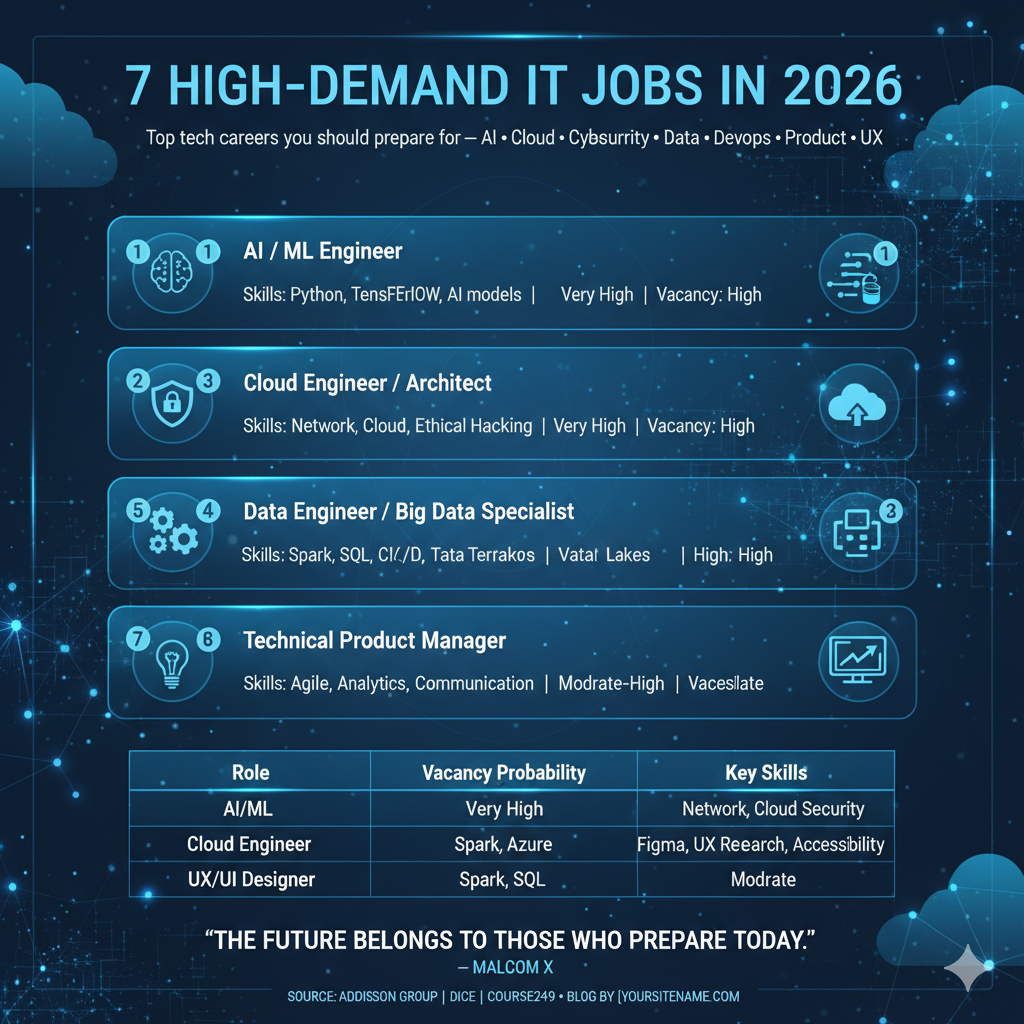
Infographic / Summary Table
Here’s a quick overview of the seven roles with key skills and vacancy probability:
| # | Role | Core Skills | Vacancy Probability* |
|---|---|---|---|
| 1 | AI / ML Engineer | Python, ML frameworks, model deployment | High |
| 2 | Cybersecurity Engineer | Network/Cloud security, risk assessment, penetration testing | Very High |
| 3 | Cloud Engineer/Architect | AWS/Azure/GCP, containers, microservices, migration | High |
| 4 | Data Engineer / Big Data Specialist | SQL/NoSQL, Spark/Hadoop, data pipelines, cloud data-platforms | High |
| 5 | DevOps / SRE | CI/CD, containers, Terraform/Ansible, monitoring & incident-response | High |
| 6 | Technical Product Manager | Product strategy, roadmap, analytics, agile methodologies | Moderate-High |
| 7 | UX/UI Designer / Human-Centred Tech | Wireframing, prototyping, UX research, accessibility | Moderate |
*Vacancy probability is a qualitative estimation based on current trends to 2026.
never give up
If you’ve made it this far, you’re ready to take the next step. Here are three motivational quotes to fuel the journey:
“Success is not final; failure is not fatal: It is the courage to continue that counts.” — Winston Churchill
“The future belongs to those who believe in the beauty of their dreams.” — Eleanor Roosevelt
“Don’t watch the clock; do what it does. Keep going.” — Sam Levenson
Your pathway to a high-demand IT career in 2026 begins with a choice: to show up, to learn, to build, and to act. The world doesn’t wait—and neither should you.
writers Thoughts
As we look ahead to 2026, the IT landscape no longer rewards generalists as much as specialists who can connect technology with business value, work across functions, and keep learning. The seven roles we discussed are not just “jobs” — they’re gateways to meaningful, future-proof careers.
Remember:
- Educate yourself about the role and market.
- Engage deeply with the required tools, trends, and soft-skills.
- Transform your mindset and capabilities accordingly.
- Act now—build a project, update your CV, network, apply.
Start today. Because in tech, tomorrow belongs to those who prepare today.
SOURCES : According to Addison Group’s 2026 IT Hiring Report, the demand for cloud and AI professionals continues to rise. Similarly, Dice confirms that 50% of all tech job listings now require AI skills.
[…] 7 High-Demand IT Jobs in 2026 — Your Guide to Trends, Skills & Opportunity […]
[…] 7 High-Demand IT Jobs in 2026 — Your Guide to Trends, Skills & Opportunity […]
[…] 7 High-Demand IT Jobs in 2026 — Your Guide to Trends, Skills & Opportunity […]