

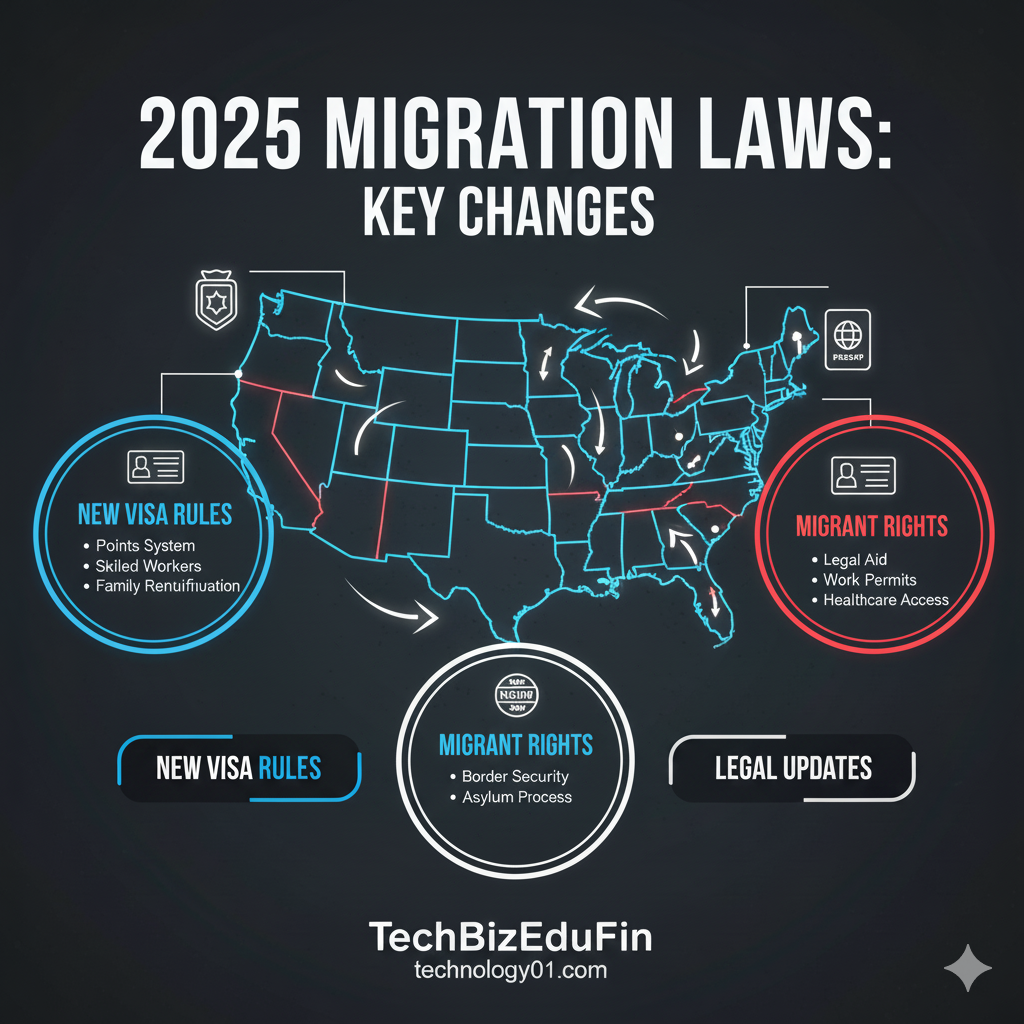
“Trump immigration updates 2025”
U.S. Migrants in the United States has always been a powerful force shaping the nation’s identity. From centuries of international immigration to modern internal mobility, migrants—whether moving between states or coming from abroad—play a vital role in the economy, culture, innovation, and diversity of the U.S. But in 2025, major legal changes are redefining what it means to be a migrant in America. This blog dives deep into the legal rights of migrants, new visa rules, penalties, the path to U.S. citizenship, and how Trump’s latest policies are influencing the landscape.
“For readers seeking simplified guides on visas, migrant rights, and U.S. policy updates, technology01.com offers easy, free, and reliable resources to help navigate every immigration change.”
A Brief History: Migrants and Immigration in the U.S.
To really understand today’s migration patterns, it helps to look back at where it all began. For more than a century, the United States has welcomed wave after wave of immigrants — from the families arriving through Ellis Island to the major labor migration of the mid-1900s. As time went on, policies such as the 1965 Immigration and Nationality Act opened the doors even wider, bringing in immigrants from regions far beyond Europe and reshaping the nation’s cultural and demographic identity.
At the same time, internal migration — Americans moving from one state to another — has always been a big part of the country’s story. Whether it was the Gold Rush, the “Go West” expansion, or today’s moves toward fast-growing tech hubs, people have consistently chased new chances and better lives. These movements were never just about switching locations. Instead, they reflected something deeply American: the search for freedom, opportunity, and the promise of a brighter future — the very heart of the American Dream.
Who Are “U.S. Migrants” Today?
When we talk about U.S. migrants, we usually refer to:
- International Immigrants – People born outside the U.S. who come here to live, work, or study.
- Refugees & Asylees – Those fleeing persecution, violence, or instability in their home countries.
- Temporary Workers / Students – Visa holders such as H-1B workers, F-1 students, or J-1 exchange visitors.
- Internal Migrants – U.S. citizens or permanent residents who move between states in search of jobs, better housing, or lifestyle changes.
- Undocumented Migrants – Individuals residing in the U.S. without official legal status.
“U.S. migrants legal rights”
“New visa rules for immigrants”
“U.S. migrants protection laws”
Understanding legal rights is crucial for migrants. Rights vary depending on status, but there are core protections and challenges all migrants should be aware of:
- Right to Due Process: Non-citizens, including many migrants, have the right to due process under U.S. law — meaning they are entitled to legal hearings before removal (deportation) in many cases.
- Asylum & Protection: Those qualifying for asylum or refugee status are legally protected if they can show credible fear of persecution.
- Work Authorization: Visa types like H-1B or EAD (Employment Authorization Document) holders have legal permission to work.
- Non-Discrimination: Migrants have rights under U.S. anti-discrimination laws (labor, housing, education) in many situations.
- Access to Courts: Many immigration decisions (deportation, green card denial) can be appealed in immigration courts.
- Penalties & Fines: Under recent rules, illegal entrants may face monetary fines, civil penalties, or detention; the U.S. can impose fines up to $100–$500 per illegal entry, $1,992–$9,970 for not honoring a departure order, and $998/day for willful noncompliance. uscis.techmis.com
- Legal Representation: Migrants can hire immigration attorneys, though they are not always guaranteed a government-paid lawyer in removal proceedings.
Key Visa Categories and U.S. Migration Paths
Here is a breakdown of important visa and migration categories, especially relevant in 2025.
Non-Immigrant Visas (Temporary)
- H-1B (Specialty Workers): One of the most common work visas. But in 2025, a new $100,000 fee applies to certain H-1B petitions filed after September 21, 2025, for beneficiaries outside the U.S. Wikipedia
- F-1 / M-1 (Students): For academic or vocational students.
- J-1 (Exchange Visitors): For cultural exchange, internships, or university programs.
- B-1 / B-2 (Tourist / Business): For temporary travel to the U.S.
- TPS (Temporary Protected Status): For migrants from countries experiencing crises. TPS protections are under pressure: in 2025, protections for Haitians and Venezuelans are being rescinded, exposing more than 500,000 migrants to deportation. AP News
Immigrant (Permanent) Visas
“Easy U.S. visa options for workers”
- Family-based Green Cards: Many migrants apply through family ties with U.S. citizens or permanent residents.
- Employment-based (EB) Visas: Includes EB-1 (priority workers), EB-2, EB-3, and EB-5 (investment-based). The EB-5 investor visa program has reopened; from October 1, 2025, applicants must invest $1.05 million (or $800,000 in certain target areas). Business Standard
- Diversity Visa (DV) Lottery: A limited visa lottery for people from countries with low immigration rates to the U.S.
- Why Americans Move States Much : Reasons Behind U.S. Mobility
Humanitarian / Special Visas
- Refugee / Asylum: Legal pathway for those fleeing persecution.
- U Visa: For victims of certain crimes in the U.S.
- SIJS (Special Immigrant Juvenile Status): For minors abused, abandoned, or neglected.
Major New U.S. Immigration Laws & Policy Changes in 2025
2025 has ushered in some of the most significant immigration policy shifts in recent years. Many of these are controversial and impose harsher penalties, stricter requirements, and higher costs. Here’s what’s new, especially under President Trump’s return:
Executive Order 14159 — “Protecting the American People Against Invasion”
“2025 U.S. immigration laws under Trump”
- Signed by Trump on January 20, 2025, this order expands expedited removal (deportation without a court hearing) for certain non-citizens.
- It also denies federal funding to sanctuary jurisdictions (cities or states that refuse to enforce some federal immigration laws).
- Institutes civil and criminal penalties for non-citizens who “fail to register” or whose presence is considered undocumented.
The Laken Riley Act
- Signed into law by President Donald J. Trump on January 29, 2025, this legislation establishes a series of mandatory federal requirements governing the detention and oversight of non-citizens accused of specific criminal offenses. The statute’s provisions are structured to enhance public safety, strengthen federal immigration enforcement, and clarify the authority of state officials in challenging federal actions related to immigration policy.
- Key Legal Provisions
- Mandatory Detention Without Bond
• Non-citizens arrested for qualifying criminal offenses — including theft, burglary, assault, and other designated crimes — must be detained without eligibility for bond.
• Local, state, and federal law enforcement agencies are required to comply with these detention mandates regardless of the individual’s immigration status (e.g., undocumented, visa holder, or lawful permanent resident).
• The statute removes judicial discretion related to bond release for individuals detained under these categories.
Expanded State Authority to Initiate Legal Action
- • The act authorizes state attorneys general to file civil actions against the federal government if they believe federal agencies are not sufficiently enforcing immigration laws.
• This provision creates a direct legal mechanism for states to challenge federal immigration practices, procedures, or resource allocation.
• States may seek injunctive relief or other court-ordered remedies to compel federal agencies to meet enforcement obligations. - Federal Accountability and Enforcement Standards
• Federal agencies responsible for immigration enforcement — including DHS, ICE, and CBP — must demonstrate consistent and measurable compliance with the act’s requirements.
• Failure to enforce qualifying detention mandates or removal procedures may expose federal entities to state-led litigation. - Legislative Intent and Public Safety Goals
• The law was introduced with the stated purpose of reducing violent crime committed by non-citizens and strengthening national security.
• During the signing ceremony, President Trump described the legislation as “very important” and noted it was intended to “keep Laken’s memory alive,” referencing a high-profile case that shaped public and legislative momentum for the bill. - 7 High-Demand IT Jobs in 2026 — Your Guide to Trends, Skills & Opportunity
Visa Interview and Application Changes
- Effective October 1, 2025, almost all nonimmigrant visa applicants must now attend in-person interviews, including age groups previously exempt (under 14, over 79). A new visa integrity fee of $250 will apply to many visa categories (B-1/B-2, F, H, J) for nationals not in Visa Waiver countries. uscis.techmis.com
H-1B Visa Fee Hike
- As noted, a $100,000 fee now applies to H-1B petitions filed by employers for workers outside the U.S., effective September 21, 2025. Wikipedia
- Exemptions: This does not apply to H-1B visa holders already in the U.S. or to extensions/changes of status. Reddit
- The administration argues this fee strengthens vetting and national interest, though critics say it’s punitive for high-skilled migrants and businesses.
Citizenship (Naturalization) Test Overhaul
- From October 20, 2025, the civics test for U.S. naturalization applicants becomes much tougher.
- Applicants now must answer 20 questions out of a pool of 128, needing at least 12 correct to pass. India Today
- Moral character is now weighted more heavily by USCIS officers, raising barriers for migrants seeking a free and easy path to citizenship. Multiplier
TPS & Deportation Protections Ending
- As of 2025, the Trump administration is ending Temporary Protected Status (TPS) for Haitian and Venezuelan migrants. Reuters
- The Supreme Court recently allowed this rollback, putting nearly 1 million migrants at risk of deportation. AP News
- Critics argue this is part of a broader hardline immigration agenda, while supporters call it enforcement of “temporary” status. TIME
Penalties and Enforcement: What Migrants Face
“Penalties for illegal entry into the U.S.”
Under the new policies, migrants face stiffer penalties if they violate immigration rules:
- Fines for illegal entry: As mentioned, unlawful entries could cost $100–$500 per attempt. uscis.techmis.com
- Voluntary departure non-compliance: Fines up to $1,992 – $9,970 if migrants ignore required departure orders. uscis.techmis.com
- Daily noncompliance fines: Up to $998/day for willful refusal to leave once a court orders removal. uscis.techmis.com
- Detention: Under the Laken Riley Act, migrants charged with certain crimes may be held without bond, effectively denying them a more “easy” legal exit or bail.
These measures reflect a very tough stance on enforcing immigration laws, aligned with Trump’s rhetoric of “law and order.”
The Path to U.S. Citizenship: Is It Still “Free” or “Easy”?
“How to get U.S. citizenship easily”
The dream of U.S. citizenship remains powerful — but in 2025, it’s becoming more difficult, more costly, and far less of a “free ride.”
- Naturalization Test: As mentioned, the new test requires 20 questions and stricter moral character evaluation. India Today
- Longer Vetting: USCIS is enhancing background checks, including using more sophisticated data checks, social media reviews, and financial scrutiny. Reddit
- Good Moral Character Requirement: “Good moral character” is being judged more strictly, creating a legal hurdle many migrants worry about. Multiplier
- No Automatic Birthright Citizenship?: One of the most controversial moves: Trump’s administration proposed ending birthright citizenship for children born in the U.S. to non-citizen parents. Indo American Center –
- Fees: While “free citizenship” isn’t literal (there are costs for application, biometrics, etc.), higher visa and enforcement costs mean many migrants pay more throughout their journey.
“If you want step-by-step tools about the best and easiest migration processes, technology01.com breaks down legal terms, new laws, and President Trump’s 2025 rules in a beginner-friendly way.”
The Role of Trump in Shaping 2025 Migration Policies
Donald Trump’s return to power in 2025 has brought a sharp pivot in immigration policy. Many of the most restrictive and enforcement-heavy changes come directly from his agenda:
- He signed Executive Order 14159 to expand removals and penalize sanctuary jurisdictions.
- The Laken Riley Act, which mandates detention without bond for non-citizens arrested for certain crimes, was his major legislative win.
- Trump supported the $100,000 H-1B fee and stricter visa interview rules so as pushing a narrative that migration should be harder, but only for certain categories.
- His administration is ending TPS protections for Haitian and Venezuelan migrants, reversing humanitarian programs and exposing many to deportation.
- On the citizenship front, his proposals to end birthright citizenship reflect a major ideological shift about who qualifies as “American.”
Why These Legal Changes Matter: Impact on Migrants & U.S. Society
- Increased Barriers for Skilled Migrants: With the H-1B fee hike, many high-skilled workers might find it too expensive or risky for employers to sponsor them.
- Tougher Citizenship Process: The new civics test and stricter moral character rules make it harder for migrants to become citizens — reducing the “easy path” many hoped for.
- Greater Risk for Vulnerable Migrants: Migrants who previously relied on TPS may now face detention or deportation.
- Economic Consequences: Enforcement-heavy policies could disrupt industries that rely on migrant labor. (For example, ICE raids in agriculture have drastic economic impact.
- Legal Uncertainty: Migrants face more fines, more detention, and more legal risk — particularly for non-citizens without strong legal support.
Comparing Old vs. New: Migration Laws Before and After
| Policy Area | Before (Pre-2025) | Now (2025, under Trump) |
| H-1B Visa | Standard fees, lottery system | New $100,000 fee for many new H-1B applications |
| Visa Interviews | Many age-based waivers | Virtually all visa applicants must interview in person |
| Naturalization Test | 100-question pool, easier pass | 128-question pool, stricter pass requirement |
| Deportation / Removal | Court hearings common | More expedited removal, fines, mandatory detention for some crimes |
| Temporary Protections (TPS) | TPS extended for many countries | TPS ending for Haitians & Venezuelans, exposing hundreds of thousands to deportation |
Real-Life Impacts: Migrants, Families & Communities
These legal shifts are not just policy on paper—they deeply affect real people:
- Skilled Workers: Tech firms and other employers may pause hiring high-skilled talent due to the massive H-1B surcharge.
- Families: Green Card or citizen applicants may now face more scrutiny, harder tests, and risk of rejection — affecting their “best, easy” path to staying.
- Refugees and Asylees: Those seeking protection may find fewer safe legal options.
- Undocumented Migrants: Facing steeper penalties, they risk detention, fines, or removal without bond.
- Community Tension: States that once protected U.S. Migrants (sanctuaries) may face funding cuts, creating more tension and uncertainty.
What Can Migrants Do to Navigate These Changes?
- Stay Informed: Immigration policy is evolving fast so Follow reliable sources like USCIS, legal aid organizations, and trusted immigration attorneys.
- Legal Advice: Hire an immigration lawyer to help with visa applications, green cards, or citizenship , The consequences of mistakes now are higher than ever.
- Document Everything: Keep records of status, visa applications, work permits, and legal correspondence because it required any time so as to show it quickly
- Act Early: Given the stricter citizenship test and other deadlines, file applications proactively.
- Know Your Rights: Even undocumented migrants have certain constitutional protections (e.g., due process).
- Advocacy & Support: Participate in immigrant rights groups, local community organizations, or pro-bono legal clinics.
Why This Matters for America’s Future
- Economic Strength: Migrants fuel innovation, start businesses, and fill critical labor gaps. Drastic policy changes could slow this engine. but
- Social Fabric: Immigrants contribute to the rich cultural diversity that defines the U.S. Curtailing legal pathways damages trust and cohesion.so
- Global Reputation: As America tightens immigration, it sends a signal to the world. Is the U.S. still a beacon of opportunity, or becoming more closed?
- Human Rights: Millions of people rely on asylum, TPS, or visas to escape crises and Legal shifts can have life-or-death consequences.
The High Stakes of Migration in 2025
In 2025, being a migrant in the United States is tougher than ever. Under Trump’s administration, the legal landscape has shifted dramatically, bringing stricter laws, heavier penalties, and far higher costs. As a result, the path to U.S. citizenship is no longer “free and easy.” Instead, migrants must navigate a complicated maze of new rules and fast-changing regulations just to stay legally in the country.
Even so, the stakes remain incredibly high. U.S. Migrants continue to fuel America’s economy, enrich its culture, and strengthen its communities. However, as these restrictive policies take hold, decades of hard-won progress now stand at risk. Therefore, it’s more important than ever for migrants, advocates, and policymakers to stay informed, speak up, and push for a system that protects both national security and human dignity.
“You can explore more free legal explanations, migrant updates, and U.S. citizenship guides anytime at technology01.com — a trusted resource helping thousands every day.”
Additional Resources
U.S. Government & Legal Sources
- USCIS – Official Immigration Information
https://www.uscis.gov - U.S. Department of State – Visa Information
https://travel.state.gov - U.S. Immigration and Nationality Act Overview
https://www.dhs.gov/immigration-statistics - U.S. DOJ – Immigration Courts & Legal Rights
https://www.justice.gov/eoir
Major News and Policy Analysis
- AP News – TPS Changes & Migrant Policy Updates
https://apnews.com - Reuters – Immigration Law Shifts
https://www.reuters.com/world/us - The Guardian – U.S. Immigration Policy Reports
https://www.theguardian.com/us-news
Research and Statistics
- Migration Policy Institute – Visual Data & Reports
https://www.migrationpolicy.org - Pew Research – U.S. Immigrant Facts
https://www.pewresearch.org - American Immigration Council – Legal Analysis
https://www.americanimmigrationcouncil.org