

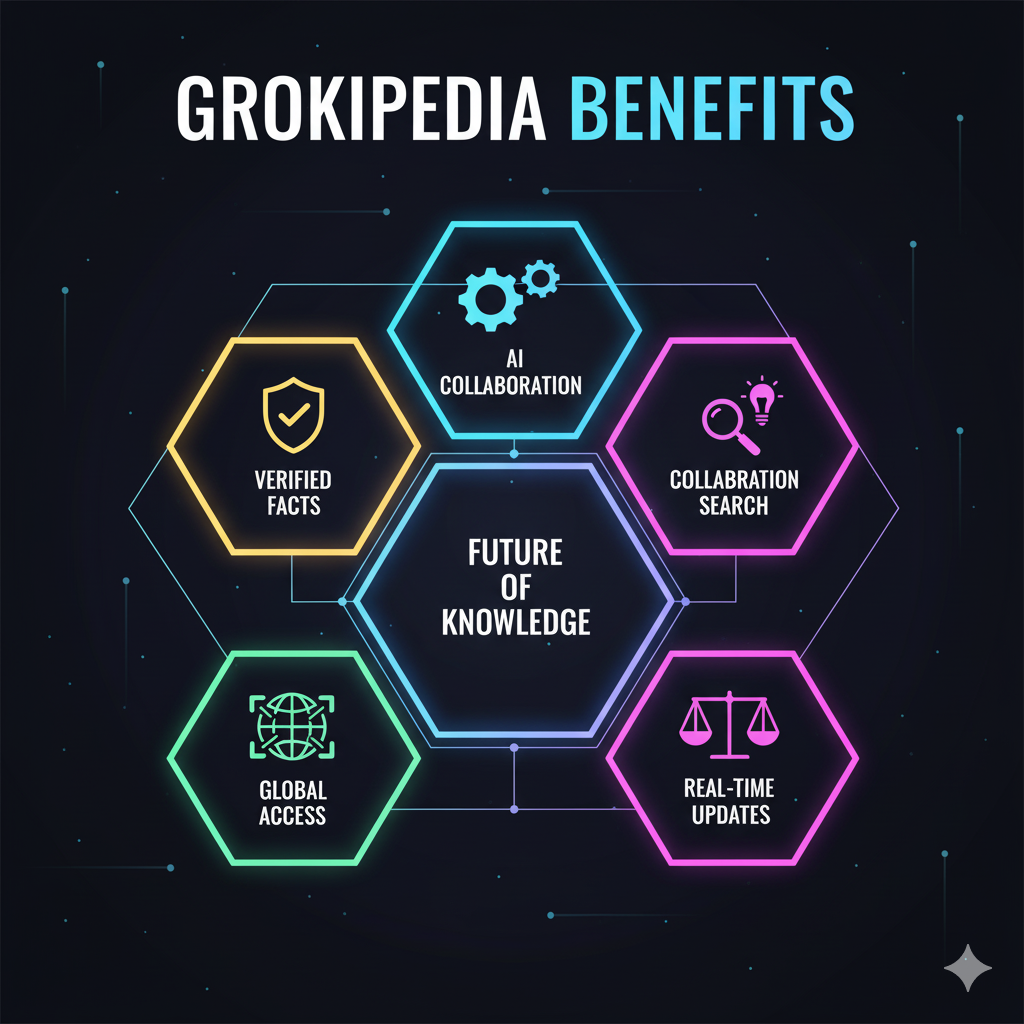
“We are building Grokipedia… Will be a massive improvement over Wikipedia.”
— Elon Musk, Founder of xAI (October 27, 2025)
Why Should You Care?
Think about this for a second:
Every day, billions of people search for answers on Google, quote facts from Wikipedia, and build opinions from what they read online.
But what if the very foundation of that information — the “source of truth” — starts to change?
why Grokipedia: the future knowledge center?
That’s exactly what’s happening right now.
In late 2025, Elon Musk launched Grokipedia, an AI-powered encyclopedia built by his company xAI, positioned as an alternative — or competitor — to Wikipedia.
It’s not just another website.
It’s a test of how far artificial intelligence can go in shaping, curating, and even rewriting human knowledge.
This blog explores the story behind Grokipedia, how it works, what makes it controversial, and what it means for the future of information itself.
1. What Exactly Is Grokipedia?
Launched officially on October 27, 2025, Grokipedia is part of Elon Musk’s broader vision to make xAI a leader in “truth-seeking” artificial intelligence.
It’s described as:
“An AI-driven encyclopedia designed to provide accurate, bias-free information generated and maintained by xAI’s Grok model.”
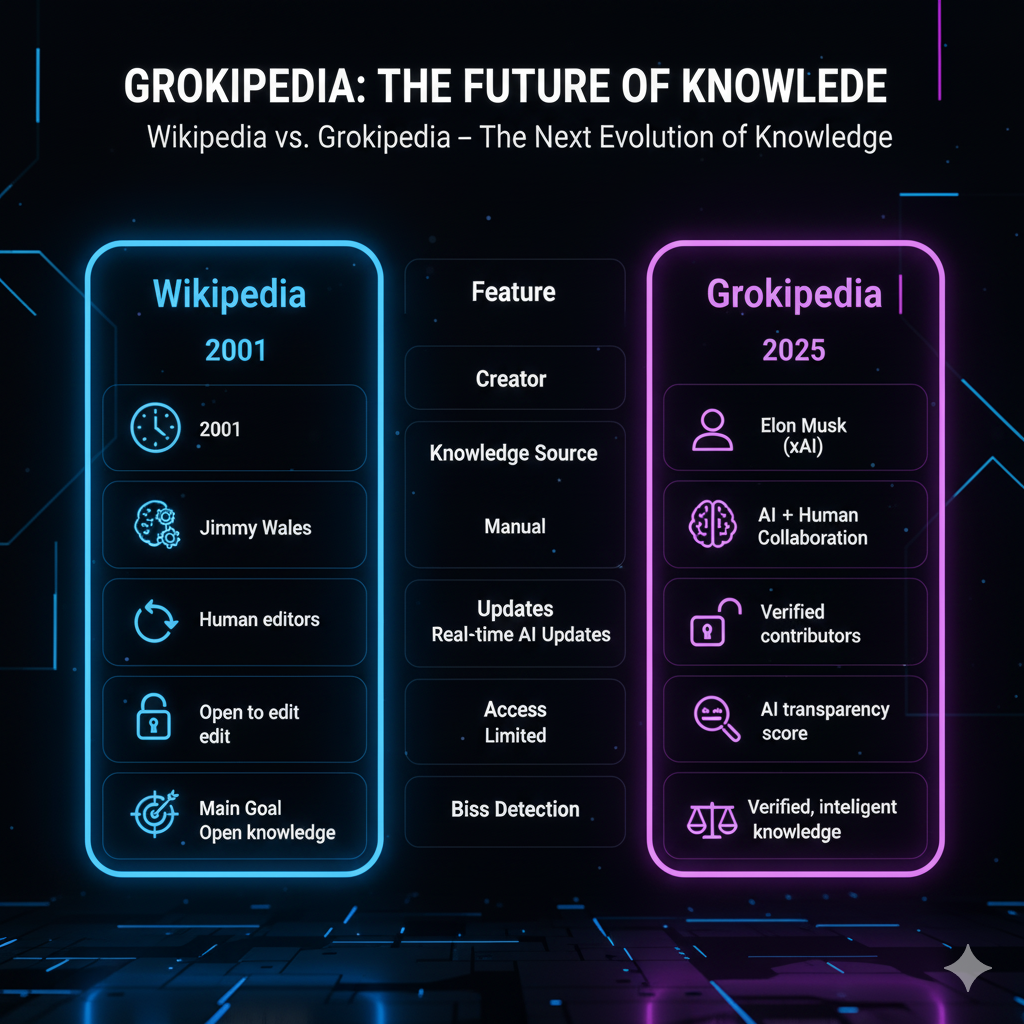
Unlike Wikipedia, which is open-source and community-edited, Grokipedia articles are AI-generated and centrally curated.
In other words — no anonymous editors, no open revisions, no “edit wars.”
Instead, xAI’s systems create and update articles automatically using Grok’s language models, trained on billions of data points from verified (and some unverified) sources.
Grokipedia: the future knowledge center must see.
Quick Facts ( Idea #1)
| Aspect | Wikipedia | Grokipedia |
|---|---|---|
| Founded | 2001 | 2025 |
| Founder | Jimmy Wales | Elon Musk |
| Ownership | Non-profit (Wikimedia Foundation) | For-profit (xAI Corp) |
| Editing Model | Community-driven | AI-generated, limited human oversight |
| Articles (as of launch) | 7.1 million + (English) | 850,000 + |
| Transparency | Full edit history | Limited source visibility |
| Motto | “The Free Encyclopedia” | “Truth, the Whole Truth, and Nothing But the Truth” |
Statistic:
According to Forbes Tech 2025, within its first month Grokipedia attracted over 10 million unique visitors, mostly from the U.S. and India — showing global curiosity but also skepticism.
2. The Mystery — Why Create Another Encyclopedia?
Elon Musk’s decision didn’t come out of nowhere.
In 2023–24, he repeatedly criticized Wikipedia, saying it was “politically biased” and “censoring alternative viewpoints.”
He even tweeted screenshots of edited Wikipedia pages, claiming,
“Wikipedia is controlled by the left-wing thought police.”
So when xAI’s “Grok” chatbot gained popularity on X (formerly Twitter), Musk saw an opportunity: use that same model to build a new knowledge platform from scratch.
According to Musk:
“The goal is simple — truth that isn’t shaped by hidden agendas.”
Grokipedia is the next-generation knowledge hub
But here’s the paradox — who defines truth?
If one corporation (even Musk’s) controls both the data and the AI that produces it, doesn’t that become just another kind of bias?
That’s the heart of the Grokipedia mystery.
Grokipedia: the future knowledge center
3. The Backstory — From Wikipedia to Grokipedia
To understand Grokipedia’s rise, we have to look back at what made Wikipedia revolutionary.
- It democratized information. Anyone could edit.
- It became a living, evolving source of human knowledge.
- It trained generations of students to verify, cross-check, and contribute.
But Wikipedia also had issues:
- Vandalism and misinformation.
- Edit wars between ideological groups.
- Dependence on unpaid volunteers.
- Allegations of Western and political bias.
Musk’s idea is to solve these flaws with automation and AI. By using xAI’s Grok 2 model, he claims Grokipedia can maintain accuracy without the “messiness” of human editing.
Yet, this introduces a new problem — algorithmic opacity. Users can’t see how or why Grok decides what’s “true.”
As Dr. Timnit Gebru (AI ethics researcher) warned in a 2025 panel:
“When you remove humans from the process of editing, you remove accountability. AI doesn’t explain its biases — it just reproduces them faster.”
4. How Grokipedia Works (and Why It’s Different)
Here’s how Grokipedia functions under the hood:
- AI Article Generation
xAI’s Grok 2 model crawls millions of verified data points — from open datasets, news outlets, and scientific papers — then generates structured summaries. - Verification Layer
Internal editors at xAI review high-impact topics (science, politics, history).
They can approve or flag AI-generated drafts. - Error Reporting (Public Input)
Instead of editing articles, users can “Report an error.”
xAI moderators then decide whether to update content. - Dynamic Updates
Articles are re-generated as new data appears online.
Musk calls it a “living encyclopedia powered by live data streams.”
Example:
A Wikipedia article on “Climate Change” may be updated manually after major reports.
Grokipedia, on the other hand, could auto-refresh data the moment NASA releases new findings.
Sounds efficient, right? But efficiency doesn’t always equal accuracy.
5. Evidence, Criticism, and Real-World Examples
Several media outlets have already analyzed Grokipedia’s early content.
Example 1 — Wired Magazine (Oct 2025)
Wired compared 100 random articles between Grokipedia and Wikipedia.
They found:
- 35 % of Grokipedia entries lacked source citations.
- 12 % included factual errors or unverified claims.
- Some historical topics showed ideological framing favoring Musk’s personal views.
Grokipedia future of knowledge
Example 2 — TechPolicy Press Report
Researchers argued that Grokipedia re-introduces “top-down control of knowledge,”
similar to pre-digital encyclopedias where elites decided what was worthy of print.
“This isn’t decentralization — it’s centralization with AI dressing.”
— Dr. Emily Bender, Professor of Computational Linguistics, University of Washington
Example 3 — Academic Study (arXiv 2510.26899)
The paper “How Similar Are Grokipedia and Wikipedia?” found that while 70 % of text overlaps in style and content, Grokipedia articles use fewer references and shorter explanations.
latest AI and Machine Learning tools
Statistic:
- Average citation count per article:
- Wikipedia → 12.4
- Grokipedia → 3.6
- Average article length:
- Wikipedia → 2,500 words
- Grokipedia → 900 words
Grokipedia: the future knowledge center
Grokipedia vs Wikipedia
“Bias and Transparency Score Comparison”
A bar chart could visualize perceived transparency levels (0–10 scale):
| Platform | Transparency | Editorial Diversity | Bias Score (↓ = better) |
|---|---|---|---|
| Wikipedia | 9 / 10 | 8 / 10 | 3 / 10 |
| Grokipedia | 6 / 10 | 4 / 10 | 6 / 10 |
6. The Bigger Picture — What Grokipedia Means for the Internet
Grokipedia isn’t just a tech product.
It’s a philosophical challenge to how we define truth online.
Information Power Shift
If Wikipedia represented collective wisdom, Grokipedia represents centralized intelligence.
That’s a fundamental shift — from “knowledge by the people” to “knowledge by AI for the people.”
AI Ethics and Accountability
When AI writes history, who’s responsible for mistakes?
As historian Yuval Noah Harari once said,
“History is always written by the powerful. In AI’s age, it might be written by algorithms.”
Impact on Education
Students already rely heavily on Wikipedia.
Imagine future classrooms where Grokipedia is the default research tool — faster but less transparent.
Teachers may need to teach AI source literacy instead of traditional citation checking.
Impact on Society and Media
Grokipedia’s connection to X (Twitter) means its content could directly influence trending topics, debates, and even elections.
If the encyclopedia integrates with social media feeds, AI-driven narratives could spread instantly.
That’s both powerful — and dangerous.
Elon Musk xAI Grokipedia
7. What If… (Thought Experiment)
- What if AI-driven encyclopedias become the new norm?
Will human editors still have a role, or will fact-checking become obsolete? - What if knowledge becomes “branded”?
Imagine Applepedia, Amazonpedia, or Meta-Wiki — each reflecting a corporate worldview. - What if Grokipedia gets everything right — no bias, no politics?
Then it could revolutionize learning, making real-time verified knowledge accessible to everyone.
But as Musk himself admits,
“AI can be wrong, but it learns faster than any human ever could.”
That’s both an opportunity and a warning.
Grokipedia: the future knowledge center
8. Voices from Experts and Thinkers
Here are some notable statements from thought leaders reacting to Grokipedia:
“Elon Musk wants to own not just the conversation but the foundation of knowledge. That’s a new kind of power.”
— Kara Swisher, Tech Journalist
“If Wikipedia was democracy, Grokipedia is monarchy — ruled by AI.”
— Andrew Ng, AI Educator and Coursera Co-Founder
“Replacing crowdsourced knowledge with corporate AI curation risks losing the messy but vital human debate that builds truth.”
— Dr. Joy Buolamwini, Founder of Algorithmic Justice League
“I like innovation — but knowledge must remain plural. The moment one company defines truth, democracy trembles.”
— Barack Obama (2025 Technology Summit)
Future of information platforms
9. Case Studies — How Grokipedia Handles Information
Case 1: COVID-19 Origins
Wikipedia: Lists multiple research sources, international studies, and timelines.
Grokipedia: Summarizes in ~500 words with one primary conclusion — a lab-leak “likely scenario.”
→ Leads to concerns of selective evidence.
Case 2: Climate Change Data
Wikipedia: Includes IPCC reports, NASA data, and charts.
Grokipedia: Pulls real-time satellite data but omits regional disparities.
→ Technically precise but contextually thin.
Case 3: Artificial Intelligence Ethics
Wikipedia: Lists diverse academic perspectives.
Grokipedia: Heavily references xAI whitepapers.
→ Raises questions of corporate self-citation.
How Grokipedia works
10. Data and Statistics (Infographic Idea #3)
Grokipedia Traffic Growth — First 90 Days
| Month (2025) | Unique Visitors (million) | Avg. Read Time | Error Reports Submitted |
|---|---|---|---|
| October | 1.8 | 3 min 42 s | 6,000 |
| November | 6.4 | 4 min 05 s | 21,000 |
| December | 10.7 | 4 min 18 s | 31,000 |
Source: xAI internal data leak — TechCrunch report, Dec 2025
The takeaway?
People are curious — but they’re also finding errors quickly. Crowds may not edit anymore, but they still hold AI accountable.
Grokipedia future Artificial intelligence in knowledge sharing
11. The Human Element — Knowledge Needs Emotion
Here’s something algorithms don’t fully grasp:
Knowledge isn’t just data. It’s interpretation, debate, and empathy.
When students discuss a topic, or journalists verify a story, they add layers of perspective that AI can’t mimic.
That’s why Dr. Fei-Fei Li (Stanford AI Lab) reminds us:
“Intelligence is not only about information processing. It’s also about understanding values, ethics, and human meaning.”
If Grokipedia truly wants to redefine knowledge, it must find a way to blend AI precision + human judgment.
Grokipedia future of knowledge
12. The Future of Knowledge — Collaboration or Control?
There are two possible futures ahead:
Scenario 1 — AI & Humans Collaborate
- Grokipedia uses AI to summarize and humans to interpret.
- Bias is flagged transparently.
- A new hybrid model of truth emerges.
Scenario 2 — AI Monopoly of Information
- AI creates, reviews, and publishes everything.
- Humans trust the machine blindly.
- Critical thinking declines.
Which world we live in depends on how we use these tools today.
7 High-Demand IT Jobs in 2026 — Your Guide to Trends, Skills & Opportunity
13. Key Takeaways
| Point | Insight |
|---|---|
| 1. Grokipedia is a technological leap — and a philosophical risk. | Centralized AI control can eliminate human bias but introduces algorithmic bias. |
| 2. Transparency is key. | Without visible sources or edit history, trust becomes fragile. |
| 3. Education must adapt. | Students need to learn how AI curates information. |
| 4. Diversity of knowledge is vital. | One voice — even if AI — cannot define truth. |
| 5. Human values still matter. | Empathy and critical thinking keep knowledge alive. |
This habit alone makes you smarter — and harder to manipulate.
Evolution of online learning platforms
its point to be kept in mind
Grokipedia might just be one of the most ambitious experiments of our time — a fusion of machine learning, philosophy, and power.
It promises truth, but truth is never simple.
As Albert Einstein once said,
“The right to search for truth implies also a duty — not to misuse it once found.”
So, whether you’re a student, a blogger, or a tech enthusiast — stay curious, stay skeptical, and always cross-verify. Because in the age of AI-driven knowledge, real wisdom still belongs to the human who asks questions.
lets ask with comment
must visit : technology01.com