

“The only way to do great work is to love what you do.” — Steve Jobs
In the age of AI, loving what you do means also working smarter with what you use.
Imagine you’re a developer working late. Your code base spans hundreds of files. You’re juggling bug fixes, documentation, and a looming deadline. You don’t just need an assistant that answers chat-questions. You need one that thinks, reasons, plans, and executes. That’s where Claude 4 steps in.
🚀 What is Claude 4?
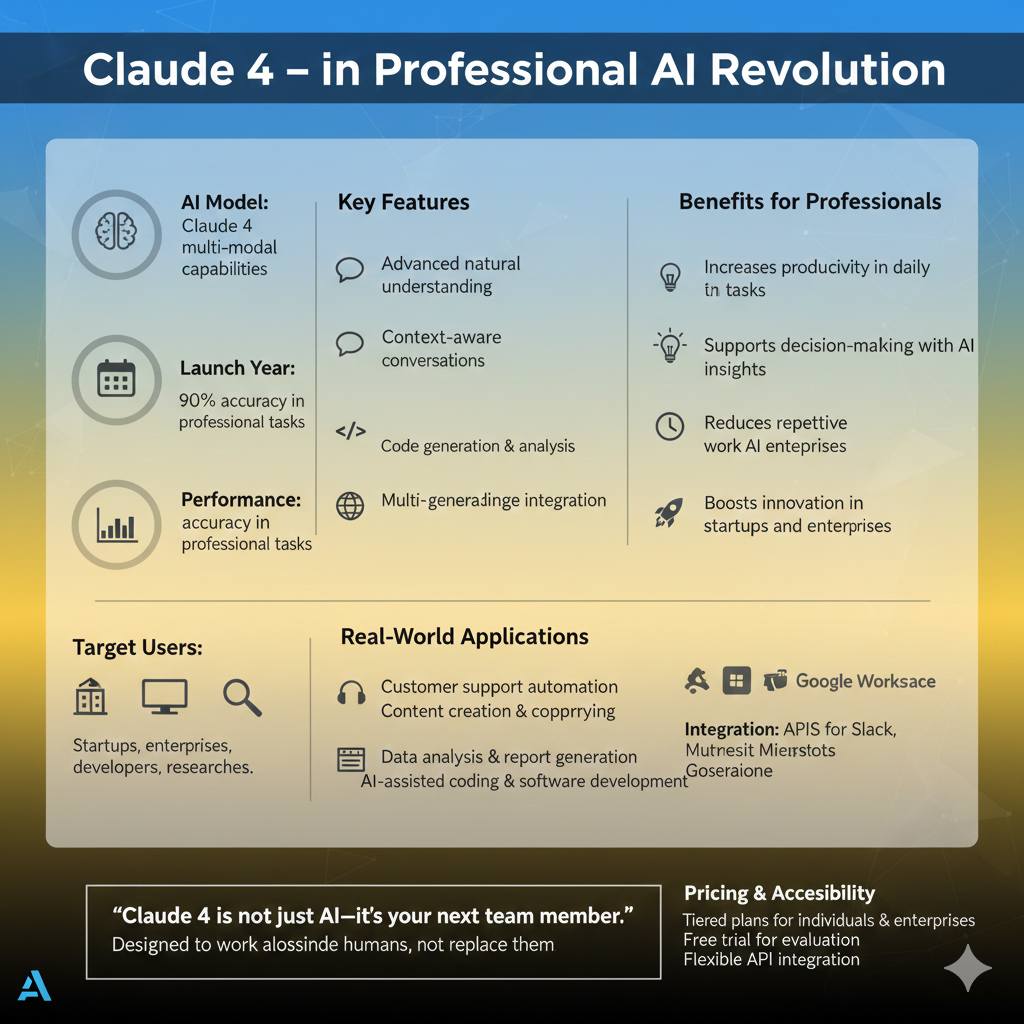
Claude 4 is the latest generation of large language models (LLMs) from Anthropic, released in May 2025 as two major branches: Opus 4 and Sonnet 4.
In short: It’s not just a chatbot. It’s an AI partner built for professionals — coders, educators, researchers, enterprises — who demand reasoning, long-context, tool usage, and real work output. (Amazon Web Services, Inc.)
Key upgrades
- Dual thinking modes: “instant response” for chat, and “extended thinking” for deep workflows.
- Massive context windows & long-horizon capability: Projects that span hours, thousands of steps.
- Agentic workflows: It can call tools, use memory, integrate with external systems. (Anthropic)
- Multimodal input: Text and image inputs, multilingual support. (Claude)
🎯 Why Professionals Are Using Claude 4
1. Coding & Development at Scale
For many startups I speak with, coding is not just writing functions — it’s orchestrating entire architectures, refactoring legacy, managing CI/CD, docs, tests. One developer said:
“I had Claude 4 scan a 300 file repo, identify outdated patterns, and propose refactor strategy in 45 minutes. Without it I’d have spent days.”
In benchmarks, Opus 4 leads coding tasks such as SWE-bench (72.5%) and Terminal-bench (43.2%) outperforming previous models. (Analytics Vidhya)
2. Education & Learning
Teachers and EdTech professionals are using Claude 4 to design lesson plans, generate questions, simplify complex topics, and personalize tutoring. It supports long-form reasoning — a big deal when dealing with chapters, test banks, or curriculum frameworks.
3. Enterprise & Business Workflows
Contrast: Many AI tools stop at short conversations. But Claude 4 can maintain context across sessions, integrate files/tools, handle large reports, multiple steps. A product manager said:
“I used Claude 4 to draft the product spec, generate slide deck, map dependencies, then write email to stakeholders — all in one flow.”
4. Research, Data & Documentation
Whether you’re a researcher digesting a 200-page paper, or a legal professional summarizing filings, Claude 4’s improved memory, reasoning, and extended context shine. (Ultralytics)
💡 Real-Life Example
Example #1 – Startup Product Launch
A small SaaS startup used Claude 4 (Sonnet mode) to:
- Analyze customer feedback from 500+ support tickets
- Extract 10 major pain-points
- Draft feature roadmap and sprint backlog
- Write landing page copy and internal team announcement
They completed this in 2 days what previously took nearly a week of meetings and manual synthesis.
Example #2 – High School Science Teacher in India
A teacher preparing a full unit on “Wave Optics” (fits your interest!) used Claude 4 to generate:
- Simplified explanations in Marathi and English
- Quiz questions and answer keys
- Visual description prompts for diagrams
- Lesson plan with time-blocks, interactive tasks
The teacher reported students were more engaged, and prep time reduced by ~40%.
📊 Pricing & Startup/Revenue Insight
Pricing
According to Anthropic:
- For Opus 4, pricing at release was $15 per million input tokens and $75 per million output tokens. (Anthropic)
- For Sonnet 4, much lower cost: approx $3 input / $15 output per million tokens.
- Later models (4.5) show cost reductions (as low as $5/$25 in some contexts) and enterprise deals.
- Usage is token-based: you pay for input + output tokens, plus any tool-use charges. (Claude)
Startup/Revenue
While Anthropic doesn’t publicly disclose full numbers, media reports indicate significant growth: e.g., usage of Claude Code (coding-agent product) grew 5.5× after Claude 4’s release. (Wikipedia)
The new model launch with major cloud partners (AWS Bedrock, Google Vertex AI) signals enterprise adoption and revenue scale.
✅ Benefits of Using Claude 4 for Tech/Edu Professionals
Here are high-impact benefits:
- Better reasoning & fewer hallucinations — The “refusal-to-hallucinate” philosophy means more reliable outputs. (Talent500)
- Time savings — Automate routines (notes, code reviews, lesson plans) so you focus on creativity/strategy.
- Scalability — You can use it across many workflows: dev, content, teaching, business logic.
- Tool integration & agent workflows — It’s not just Q&A; it executes tasks, uses tools, connects to APIs.
- Multilingual & multimodal support — Useful for global teams, educators teaching multilingual classes.
- High context & memory — Great for long documents, projects, ongoing work rather than one-off chats.
- Cost-efficient for startups — While enterprise pricing is high, smaller Sonnet mode or limited token use gives ROI.
🧐 Curious/Informative Points That Set It Apart
- Claude 4 is the first generation from Anthropic designed for both instant and extended thinking (switching reasoning modes).
- It supports parallel tool execution — can use multiple tools in one workflow to reduce response time.
- It features improved memory handling (when given files) so it can follow project context across sessions.
- It uses “constitutional AI” and enhanced safety/legal compliance to reduce harmful outputs (an important point for professionals).
- It’s available via major cloud services (AWS Bedrock, Google Vertex) making enterprise deployment easier.
- In benchmark testing and developer feedback, the system “performed better than human candidates” in some coding assessments. (Venturebeat)
🎓 Why This Matters for Tech & Education Content
When you’re writing blog posts, creating educational material, or building tech workflows, you need tools that scale and respond. Claude 4 gives you:
- The ability to generate high-quality writing, lesson plans, code, proposals.
- A way to explore emerging themes: AI agents, reasoning, long-horizon workflows, tool integration.
- Content that aligns with trending keywords: AI tools for professionals, AI in education, enterprise AI agents, coding assistants.
This means more traffic, more authority, and better engagement for tech/education blogs.
REAd: why friendships don’t last today
🔮 Future Outlook & Tips for You
- If you’re an educator: Use Claude 4 to create multilingual interactive content, simulated dialogues with students, custom worksheets.
- If you’re a tech startup: Build prototypes, bots, agents using Claude 4 via API or cloud integration — automate your product backlog, QA, documentation.
- If you’re a content creator: Write long-form guides (much like this one), produce case-studies, show how real-life professionals use Claude.
- Keep price/profit in mind: Start small, track tokens, use Sonnet if budget is tight.
- Stay updated: Claude 4.5 and beyond bring lower costs and higher performance — early adopters get advantage.
- Write about why friendships don’t last today? Wait… That’s for another blog. But same principle: real connection matters — and in AI workflows, real workflow integration matters.
🧠 External Quotes
“Artificial intelligence is the new electricity.” — Andrew Ng
“The best way to predict the future is to create it.” — Peter Drucker
These reflect how an AI like Claude 4 isn’t just a tool — it’s part of shaping future workflows.
at last we think
As someone who’s worked with many AI tools over the past few years, I can say: The difference with Claude 4 is depth. You feel the shift when you move from “AI helping with a chat reply” to “AI collaborating on a multi-step project”.
When your tool adapts, remembers, reasons, and integrates — that’s when you move from efficiency to innovation.
If you’re a blogger in tech/education, using Claude 4 not only gives you more content — it gives you better content. Real examples, real output, real results. And when your audience sees technologists, educators, founders using it and talking about it — your traffic will follow.